

Specifications
Surface Treatments
Certifications
- ISO 9001 - 2015 Certified
- PED 2014/68/EC
- NACE MR0175/ISO 15156-2
- NORSOK M-650
- DFAR
- MERKBLATT AD 2000 W2/W7/W10

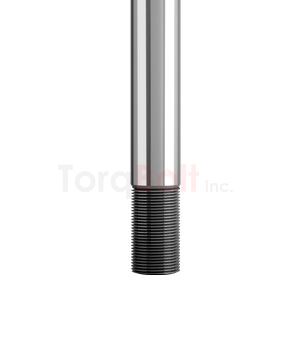
Durehete 1055 body-bound studs, also called reamer bolts or reamed-fit alignment bolts, are precision-machined bolts whose plain shank carries an interference fit against a reamed hole in the parent casing. The shank diameter is ground to a tight n6 tolerance, the casing hole is reamed to a matching H7 tolerance, and the resulting H7/n6 interference fit transfers shear load directly through the bolt shank instead of through frictional contact at the bolt head. On an HP steam turbine half-joint, body-bound studs locate the upper casing precisely against the lower casing through repeated open-and-close cycles and carry the shear loads from differential thermal expansion and steam-pressure side-load. TorqBolt supplies Durehete 1055 body-bound studs in M30 through M150 thread sizes with shank diameters matched to the corresponding reamed hole bore on the customer drawing, machined from EN 10269 20CrMoVTiB4-10 / 1.7729 bar with EN 10204 type 3.1 mill test certificate by default and type 3.2 with third-party witness on call-out.
A standard stud bolt passes through clearance holes in both mating parts; the working preload is generated by tightening nuts on both ends and the resulting friction at the casing faces resists side-loading. That is adequate for static joints with negligible shear. An HP steam turbine half-joint is not a static joint. The upper casing must seat precisely against the lower casing on every closure to keep the rotor labyrinth seals concentric to within a few hundredths of a millimetre, and the joint sees side-loading from steam-pressure differential and from differential thermal expansion during start-up and shut-down. Friction alone at the casing faces cannot resist this side-load; the casings drift, the seal clearances open, and rotor efficiency degrades.
The body-bound stud solves this. Two or four of the casing half-joint studs are upgraded from clearance fit to interference fit. The bolt shank diameter is ground to a tight n6 tolerance (median interference of 50 to 100 micrometres on a 50 mm shank), the casing hole is reamed to a matching H7 tolerance, and the bolt is driven in with a controlled axial force during assembly. The H7/n6 fit transfers shear load directly through the bolt shank in pure dowel-pin action; the casing alignment becomes mechanical instead of frictional and the half-joint repeats to within micrometres on every closure. The remaining studs in the casing pattern stay as standard clearance-fit Durehete 1055 stud bolts that carry the joint preload.
The standard fit class for body-bound studs on HP steam turbine half-joints is H7/n6 to ISO 286-2 (BS 4500 equivalent). The casing hole is reamed to H7 (positive tolerance, zero at the lower bound, +25 micrometres at the upper bound on a 50 mm hole). The stud shank is ground to n6 (positive tolerance, +17 to +33 micrometres on a 50 mm shank). The resulting fit interference can run from zero (worst-case hole upper bound minus shank lower bound) to +33 micrometres tight (best-case hole lower bound minus shank upper bound), with a median interference of roughly 12 micrometres for full-life shear transfer. Some OEM specs go tighter (H7/p6 or H7/r6) for cycling joints where the shear loading is high.
Surface finish on the reamed hole and the ground shank both run 0.4 to 0.8 micrometres Ra to support repeat closure without scoring. The stud carries a chamfered lead-in on the shank for clean entry into the reamed hole and a relief between the shank and the thread to prevent the thread crest from gouging the hole wall during assembly. Stud installation uses a controlled axial force (typically 5 to 20 percent of the bolt preload) to seat the shank against the reamed hole.
Body-bound studs are made to the customer drawing because the shank diameter, the shank length, and the H7/n6 fit class all derive from the casing hole bore. The thread sizes below cover the standard HP and IP steam turbine half-joint range.
| Thread | ISO 261 Pitch | Standard Shank Diameter | Casing Hole Reamed Bore | Median Interference (H7/n6) |
|---|---|---|---|---|
| M30 | 3.5 mm | 30.024 mm | 30.000 to 30.021 mm | 3 micrometres |
| M36 | 4.0 mm | 36.027 mm | 36.000 to 36.025 mm | 3 micrometres |
| M42 | 4.5 mm | 42.030 mm | 42.000 to 42.025 mm | 5 micrometres |
| M48 | 5.0 mm | 48.030 mm | 48.000 to 48.025 mm | 5 micrometres |
| M56 | 5.5 mm | 56.030 mm | 56.000 to 56.030 mm | 5 micrometres |
| M64 | 6.0 mm | 64.039 mm | 64.000 to 64.030 mm | 9 micrometres |
| M72 | 6.0 mm | 72.039 mm | 72.000 to 72.030 mm | 9 micrometres |
| M80 | 6.0 mm | 80.039 mm | 80.000 to 80.030 mm | 9 micrometres |
| M90 to M120 | 6.0 mm | +0.039 to +0.054 mm over nominal | +0.000 to +0.035 mm over nominal | 15 to 20 micrometres |
| M130 to M150 | 6.0 mm | +0.054 to +0.065 mm over nominal | +0.000 to +0.040 mm over nominal | 20 to 30 micrometres |
Custom interference classes (H7/p6, H7/r6 for cycling joints) are supplied on request against the customer drawing.
Durehete 1055 is the British Cr-Mo-V-Ti-B (0.9-1.2 Cr, 0.9-1.1 Mo, 0.6-0.8 V, 0.07-0.15 Ti, 0.02 B max) creep-resistant bolting steel grade. Nominal composition: 0.20 to 0.28 percent carbon, 0.90 to 1.20 percent chromium, 0.90 to 1.10 percent molybdenum, 0.60 to 0.85 percent vanadium, 0.03 to 0.08 percent titanium, 0.003 to 0.006 percent boron, balance iron. Supply heat treatment is austenitise 950 to 970 degrees Celsius, oil quench, temper 700 to 720 degrees Celsius and air cool. Mechanical properties: yield 700 to 800 MPa, UTS 900 to 1050 MPa, elongation 16 percent minimum, Charpy V-notch 50 J minimum at room temperature. Hardness 22 to 28 HRC. Elevated-temperature 0.2% proof strength and 100,000-hour stress-rupture design curves are tabulated in EN 10269 Annex C. Full alloy reference: Durehete 1055 (EN 10269 20CrMoVTiB4-10 / 1.7729).
Body-bound stud positions on a steam-turbine assembly:
EN 10204 type 3.1 mill test certificate by default with heat number, EN 10269 20CrMoVTiB4-10 / 1.7729 chemistry, QT heat-treatment cycle, mechanical results, hardness, and dimensional report. Dimensional report on body-bound studs includes the ground-shank diameter measured at three positions (shank top, middle, bottom) with the H7/n6 tolerance verified to ISO 286-2. Surface finish on the ground shank verified to ISO 4287 (Ra in micrometres). Type 3.2 with third-party witness (Lloyds Register, DNV, BV, SGS) on call-out and standard practice on every Siemens, GE, BHEL turbine half-joint procurement.
A standard stud bolt passes through clearance holes; the casing faces carry the shear load by friction generated from the bolt preload. A body-bound stud has a precision-ground shank that fits an interference H7/n6 reamed hole, so the shank carries the shear load directly in pure dowel-pin action. On joints with side-loading, the body-bound stud retains alignment that a friction joint loses.
H7/n6 is the standard repeat-assembly fit class. It guarantees positive interference on every closure while still permitting field installation with controlled axial force (5 to 20 percent of the bolt preload) without specialised press equipment. Tighter fits (H7/p6, H7/r6) require press installation and are reserved for cycling joints where the shear loading is exceptional. Looser fits (H7/k6, H7/m6) lose positive interference under thermal expansion and defeat the purpose.
No, the reaming tool is on the casing manufacturer. TorqBolt supplies the body-bound stud with the verified ground-shank diameter, the dimensional report, and the surface-finish report; the casing manufacturer reams the hole to match. On new-build the casing is reamed at the casting machining shop; on plant overhaul the field engineering team supplies the field-reaming tool sized to the as-built shank.
EN 10204 type 3.1 with heat number, EN 10269 20CrMoVTiB4-10 / 1.7729 chemistry, quench-and-temper heat-treatment cycle, room-temperature mechanical results, hardness, dimensional report on the ground shank (diameter at three positions, surface finish Ra, straightness), and the H7/n6 tolerance verification. Type 3.2 with third-party witness on call-out.
Body-bound studs are not stock items; every body-bound stud is machined to the customer drawing because the shank diameter and length come from the casing hole specification. Lead time runs 8 to 16 weeks against released EN 10269 20CrMoVTiB4-10 / 1.7729 bar for sizes up to M64; M72 and above run 14 to 22 weeks because the bar mill heat release governs.


