

Specifications
Surface Treatments
Certifications
- ISO 9001 - 2015 Certified
- PED 2014/68/EC
- NACE MR0175/ISO 15156-2
- NORSOK M-650
- DFAR
- MERKBLATT AD 2000 W2/W7/W10

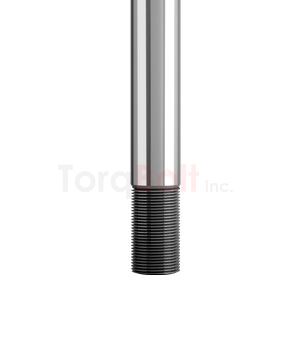
Durehete 1055 tap studs are tapped stud bolts machined from EN 10269 20CrMoVTiB4-10 / 1.7729 Cr-Mo-V-Ti-B creep-resistant bar for HP steam-turbine casing bolting at continuous service to 565 degrees Celsius. One end of the stud is threaded into a tapped hole in the casing (the "tap end"), and the other end is left free to carry a nut against the mating casing or cover. The tap-stud arrangement avoids a through-bolt design where the bolt would have to span the full casing thickness, which on an HP turbine half-joint can run 300 to 600 mm. TorqBolt supplies tap studs in M16 through M120 thread sizes and lengths from 50 mm through 800 mm against released EN 10269 20CrMoVTiB4-10 / 1.7729 bar, with EN 10204 type 3.1 mill test certificate by default and type 3.2 with third-party witness on call-out. Companion hardware includes the Durehete 1055 nuts in matching grade, and Durehete 1055 threaded rod when the tap-stud blank is supplied to the OEM for in-house length cutting.
A tap stud is a stud bolt with a threaded "tap end" that screws permanently into a tapped hole in the parent component, leaving the "nut end" projecting to accept a nut from the mating part. The tap end and the nut end usually carry the same thread size and pitch; the tap-end thread is the standard fit and the nut-end thread is the working thread that takes the bolt preload. On an HP steam turbine, the lower casing carries the tap-end threads as permanent installations, the upper casing has clearance holes, and the joint is closed by threading nuts onto the projecting nut ends. The half-joint can be opened for inspection or rotor access by removing only the nuts — the studs stay threaded into the lower casing and remain aligned for the next closure. The alternative is a through-bolt design, which forces the field crew to align two casings, two stud holes, and a free stud during every closure on a casing that may be at 200 degrees Celsius residual temperature.
Why Durehete 1055. The casing of an HP steam turbine sees elevated metal temperatures Annex C and the bolting carries the joint preload through long thermal soaks. Ordinary low-alloy steel bolting (ASTM A193 B7 / B16) loses preload to creep relaxation within a few thousand hours at that temperature. Durehete 1055 is the British Cr-Mo-V-Ti-B (0.9-1.2 Cr, 0.9-1.1 Mo, 0.6-0.8 V, 0.07-0.15 Ti, 0.02 B max) grade developed specifically for HP steam-turbine bolting; the titanium and boron microalloy additions pin grain-boundary creep and the V carbide precipitates pin dislocation creep, delivering the elevated-temperature creep performance tabulated in EN 10269 Annex C. Refer to the EN 10269 design curves for the stress-rupture envelope used in HP turbine half-joint specification.
Thread to ISO 261 coarse pitch. Length convention is overall stud length tap-end-to-nut-end including both thread runs. Standard chamfers and thread reliefs per BS 4882 / DIN 938 / DIN 939. Tap-end thread length conventionally 1.0 to 1.25 times the major diameter; nut-end thread length is the stud length minus the tap-end length and the central plain shank.
| Thread | ISO 261 Pitch | Length Range | Typical Tap-End Length | Casing Hole Tap Spec |
|---|---|---|---|---|
| M16 | 2.0 mm | 50 to 200 mm | 20 mm | BS 3643-1 / ISO 965-1 6H |
| M20 | 2.5 mm | 60 to 240 mm | 25 mm | BS 3643-1 / ISO 965-1 6H |
| M24 | 3.0 mm | 80 to 300 mm | 30 mm | BS 3643-1 / ISO 965-1 6H |
| M30 | 3.5 mm | 100 to 360 mm | 38 mm | BS 3643-1 / ISO 965-1 6H |
| M36 | 4.0 mm | 120 to 440 mm | 45 mm | BS 3643-1 / ISO 965-1 6H |
| M42 | 4.5 mm | 140 to 500 mm | 52 mm | BS 3643-1 / ISO 965-1 6H |
| M48 | 5.0 mm | 160 to 560 mm | 60 mm | BS 3643-1 / ISO 965-1 6H |
| M56 | 5.5 mm | 180 to 620 mm | 70 mm | BS 3643-1 / ISO 965-1 6H |
| M64 | 6.0 mm | 200 to 680 mm | 80 mm | BS 3643-1 / ISO 965-1 6H |
| M72 | 6.0 mm | 240 to 720 mm | 90 mm | BS 3643-1 / ISO 965-1 6H |
| M80 | 6.0 mm | 280 to 760 mm | 100 mm | BS 3643-1 / ISO 965-1 6H |
| M90 to M120 | 6.0 mm | 320 to 800 mm | 110 to 150 mm | BS 3643-1 / ISO 965-1 6H |
Durehete 1055 is the trade name for the EN 10269 20CrMoVTiB4-10 / Werkstoff 1.7729 creep-resistant bolting steel, current EN 10269 specification holder Tata Steel UK (formerly Corus) in the 1960s for the British power-generation programme. The grade is a 1Cr-1Mo-0.75V steel with Ti and B microalloy additions to refine grain size and pin grain-boundary creep. Nominal composition: 0.20 to 0.28 percent carbon, 0.90 to 1.20 percent chromium, 0.90 to 1.10 percent molybdenum, 0.60 to 0.85 percent vanadium, 0.03 to 0.08 percent titanium, 0.003 to 0.006 percent boron, balance iron. ASTM A193 B16 is the closest American bolting equivalent for the Durehete family; the British grade has tighter Ti and B control and is the named call-out on European, US, Japanese, and Indian HP turbine specification programmes.
Mechanical properties on the supply condition (quench and temper): yield 700 to 800 MPa, UTS 900 to 1050 MPa, elongation 16 percent minimum in 5.65 root A_o, Charpy V-notch 50 J minimum at room temperature. Elevated-temperature 0.2% proof strength and 100,000-hour stress-rupture design curves are tabulated in EN 10269 Annex C. Detailed chemistry, heat-treatment cycle, and creep-strength reference data are on the Durehete 1055 alloy reference page.
The bar arrives at TorqBolt in the quench-and-temper condition supplied: austenitise at 950 to 970 degrees Celsius, oil quench, temper at 700 to 720 degrees Celsius and air cool. The tempered structure is fine-grain bainite with V4C3 carbide precipitation and a small fraction of retained austenite stabilised by the boron addition. Hardness in the supply condition runs 22 to 28 HRC and is the working hardness for the stud at service temperature. Re-heat-treatment after stud machining is not required because tap-stud machining is a cold-cutting operation that does not exceed 200 degrees Celsius at the cutting edge with proper coolant flood, well below the lower critical temperature.
Where machining is hot or where the stud has been re-coined or thread-rolled at elevated temperature, the bar reverts to a fresh quench-and-temper cycle in a vacuum furnace to restore the supply microstructure. The QA spec for thread rolling on Durehete 1055 caps the thread-blank pre-heat at 250 degrees Celsius to keep the supply microstructure undisturbed.
Durehete 1055 tap studs are the standard call-out on the HP and IP casing half-joint of every major European and Asian HP steam turbine.
EN 10204 type 3.1 mill test certificate by default with heat number, EN 10269 20CrMoVTiB4-10 / 1.7729 chemistry, QT heat-treatment cycle record, room-temperature mechanical results (yield, UTS, elongation, Charpy V-notch), hardness, and dimensional report. Type 3.2 with third-party witness (Lloyds Register, DNV, BV, SGS) on call-out and standard practice on every Siemens, GE, BHEL turbine procurement. Creep-rupture certification on call-out per the ECCC data set; TorqBolt does not generate fresh creep data but cross-references the published EN 10269 20CrMoVTiB4-10 / 1.7729 creep-rupture envelope.
A standard stud bolt is threaded both ends and accepts nuts on both ends; it passes through clearance holes in both mating parts. A tap stud is threaded both ends but one end (the tap end) is screwed permanently into a tapped hole in the parent component, and only the other end (the nut end) takes a nut. The tap end and the nut end may carry the same thread or different threads; on Durehete 1055 turbine bolting both ends are the same metric thread for serviceability.
A threaded rod is fully threaded along its length and is supplied in long bar stock to be cut to length on site. A tap stud is machined to a specific length with defined tap-end thread, plain central shank, and nut-end thread. The shank diameter equals the thread minor diameter or a slightly smaller relief; the shank length plus the two thread lengths defines the overall stud length. Threaded rod is a low-cost commodity; tap studs are precision-machined items typically supplied against an OEM drawing.
TorqBolt stocks Durehete 1055 bar in common HP turbine sizes (M24 through M64 in 200 mm to 600 mm cut lengths) at Mumbai. Larger sizes (M72 through M120) are made to order against released EN 10269 20CrMoVTiB4-10 / 1.7729 bar mill heats with a 14 to 22 week lead time. Tap-stud machining from released bar is 4 to 8 weeks for sizes up to M48 and 8 to 14 weeks for M56 and above.
EN 10204 type 3.1 with heat number, EN 10269 20CrMoVTiB4-10 / 1.7729 chemistry, quench-and-temper heat-treatment cycle, room-temperature mechanical results (yield, UTS, elongation, Charpy), hardness reading per BS EN ISO 6508-1, and dimensional report. Type 3.2 with third-party witness on call-out (Lloyds Register, DNV, BV, SGS). Creep-rupture data referenced to the ECCC data set on request.
From released stock at Mumbai (M24 through M64 in standard lengths), 4 to 8 weeks against the customer drawing. For sizes M72 through M120 or non-standard lengths, 14 to 22 weeks against fresh bar mill release. Air freight from Mumbai (CSIA) to Europe and North America is 4 to 7 days door-to-door against released studs.


