

Specifications
Surface Treatments
Certifications
- ISO 9001 - 2015 Certified
- PED 2014/68/EC
- NACE MR0175/ISO 15156-2
- NORSOK M-650
- DFAR
- MERKBLATT AD 2000 W2/W7/W10

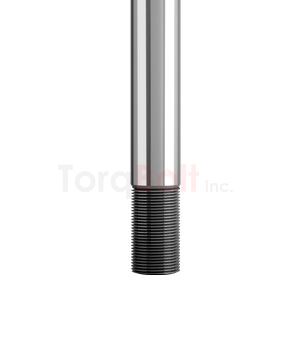
Durehete 1055 weld studs are drawn-arc stud-welded fasteners machined from EN 10269 20CrMoVTiB4-10 / 1.7729 Cr-Mo-V-Ti-B bar for steam-turbine hardware that operates at elevated metal temperatures design envelope. The weld stud is welded directly to the parent casing or heat-shield plate using a drawn-arc stud welding gun; no clearance hole is drilled in the parent metal. Once welded, the stud projects from the surface and accepts a nut to retain insulation blankets, thermocouple wells, or sheet-metal heat shielding. TorqBolt supplies Durehete 1055 weld studs in M6 through M30 thread sizes and lengths from 12 mm to 150 mm, with the standard ISO 13918 weld stud geometry (collar diameter 1.4 times the thread major, weld base ferrule profile suitable for the drawn-arc cycle). Companion hardware: matched Durehete 1055 nuts and Durehete 1055 washers in matching grade.
A weld stud is a fastener with a threaded shank and a weld base that is fused to a parent metal surface by drawn-arc stud welding. The end product is a permanently anchored stud that projects from the parent surface, with no through-hole and no rear access required. Typical applications on a steam turbine include three positions. First, insulation pin anchors: M6 to M10 weld studs welded in a regular grid across the HP casing exterior to retain mineral-wool insulation blankets under a stainless-steel sheet cover. Second, thermocouple well retainers: M10 to M16 weld studs around a thermocouple penetration to clamp a sheet-metal weather cap. Third, heat-shield attachments: M16 to M30 weld studs welded to the casing or steam-pipe surface to retain a removable Inconel sheet heat shield over the HP throttle valve or main-stop-valve assembly.
Why Durehete 1055 specifically. The parent casing of an HP steam turbine is itself a Cr-Mo-V casting (typically ASTM A356 / A217 grade C12A or EN 10269 20CrMoVTiB4-10 / 1.7729). To stud-weld onto a Cr-Mo-V casing the weld stud chemistry must match the parent so the weld zone does not become a metallurgical mismatch under thermal cycling. Plain low-carbon weld studs (the commodity ISO 13918 grade) cannot be welded onto Cr-Mo-V casing without dilution and a softened heat-affected zone that fails in service within a few thousand hours. Durehete 1055 weld studs match the parent casing and survive the full plant life.
Drawn-arc stud welding is a one-cycle fusion process that takes 200 to 1500 milliseconds depending on stud size. The welding gun grips the stud, presses it against the parent surface, lifts it 1 to 3 mm to draw an arc, holds the arc 150 to 1200 milliseconds while the stud base and the parent surface both melt, then plunges the molten stud into the molten parent pool and holds for solidification. A ceramic ferrule around the weld zone contains the arc plasma and shapes the resulting weld collar. The full cycle is automatic and the operator-skill requirement is low.
Pre-heat is required on Cr-Mo-V parent casings to prevent hydrogen-induced cold cracking in the weld heat-affected zone. The standard pre-heat for Durehete 1055 weld studs on a Cr-Mo-V casing is 150 to 250 degrees Celsius local pre-heat (oxy-fuel torch or electric resistance pad), maintained through the weld and the immediate post-weld cooling. Post-weld heat treatment (PWHT) at 690 to 720 degrees Celsius for 1 hour per 25 mm of effective casing thickness is required on heavy-section casings; thin-section heat-shield retainers usually escape PWHT under the ASME Section IX / AWS D1.6 rules.
Standard ISO 13918 weld stud geometry. The weld base end carries the small drawn-arc ignition tip; the threaded end carries the working thread. Length convention is overall stud length from the weld-base contact face to the threaded tip after welding (which deducts roughly 1 to 2 mm of stud burn-off).
| Thread | ISO 261 Pitch | Length Range (post-weld) | Weld Collar Diameter | Typical Application |
|---|---|---|---|---|
| M6 | 1.0 mm | 12 to 50 mm | 8.4 mm | Insulation pin anchor |
| M8 | 1.25 mm | 16 to 60 mm | 11.2 mm | Insulation pin anchor, light heat shield |
| M10 | 1.5 mm | 20 to 80 mm | 14.0 mm | Insulation, thermocouple weather cap |
| M12 | 1.75 mm | 25 to 100 mm | 16.8 mm | Thermocouple weather cap, light shield |
| M16 | 2.0 mm | 30 to 120 mm | 22.4 mm | Heat-shield attachment |
| M20 | 2.5 mm | 40 to 130 mm | 28.0 mm | Heavy heat-shield attachment |
| M24 | 3.0 mm | 50 to 140 mm | 33.6 mm | Heavy heat-shield attachment |
| M30 | 3.5 mm | 60 to 150 mm | 42.0 mm | Structural heat shield (HP throttle, main-stop valve) |
Durehete 1055 weld studs are turned from the same EN 10269 20CrMoVTiB4-10 / 1.7729 bar as the rest of the Durehete 1055 product family. Nominal composition is Cr-Mo-V-Ti-B (0.9-1.2 Cr, 0.9-1.1 Mo, 0.6-0.8 V, 0.07-0.15 Ti, 0.02 B max) per the Durehete 1055 alloy reference. Supply heat treatment is austenitise 950 to 970 degrees Celsius, oil quench, temper 700 to 720 degrees Celsius and air cool. Hardness 22 to 28 HRC. Mechanical properties: yield 700 to 800 MPa, UTS 900 to 1050 MPa, elongation 16 percent minimum, Charpy V-notch 50 J minimum at room temperature. Elevated-temperature 0.2% proof strength and 100,000-hour stress-rupture design curves are tabulated in EN 10269 Annex C.
Where Durehete 1055 weld studs are specified on a steam turbine assembly:
EN 10204 type 3.1 mill test certificate by default with heat number, EN 10269 20CrMoVTiB4-10 / 1.7729 chemistry, QT heat-treatment cycle, mechanical results, hardness, and dimensional report. Type 3.2 with third-party witness on call-out (Lloyds Register, DNV, BV, SGS). Drawn-arc weldability qualification to ISO 14555 / AWS D1.6 procedure-qualification record (PQR) on request; TorqBolt supplies witness coupons of the stud lot for the customer to run their own qualification weld trials.
Not on a Cr-Mo-V casing. A plain ISO 13918 mild-steel weld stud welded onto a 1Cr-1Mo-0.75V parent dilutes the weld zone and creates a soft heat-affected zone in the parent casing surface. Under thermal cycling that soft zone is the failure initiation point. Every European HP turbine procurement spec mandates a parent-matching weld-stud chemistry on Cr-Mo-V casings, which is Durehete 1055 or the closest EN 10269 grade match.
Yes when welded onto a Cr-Mo-V parent casing. Standard pre-heat is 150 to 250 degrees Celsius local pre-heat maintained through the weld and the immediate post-weld cool. The pre-heat suppresses hydrogen-induced cold cracking in the weld heat-affected zone of the parent casing. For thin-section heat-shield plate (less than 6 mm parent thickness) the pre-heat requirement is sometimes waived under ASME Section IX rules.
A standard ISO 13918 ceramic ferrule sized to the stud thread diameter. TorqBolt does not supply ceramic ferrules but the stud weld-base profile matches the standard ISO 13918 ferrule range available from every drawn-arc stud welding equipment supplier (Nelson, Soyer, Koster, Tucker).
EN 10204 type 3.1 with heat number, EN 10269 20CrMoVTiB4-10 / 1.7729 chemistry, quench-and-temper heat-treatment cycle, room-temperature mechanical results, hardness, and dimensional report. Type 3.2 with third-party witness on call-out. Weld stud lot witness coupons supplied on request for customer PQR.
From released stock, 4 to 8 weeks for M6 through M16 sizes in standard lengths. M20 through M30 sizes run 8 to 12 weeks against released EN 10269 20CrMoVTiB4-10 / 1.7729 bar. Air freight from Mumbai is 4 to 7 days door-to-door against released studs.


